In 2026, Meta’s AI-driven enforcement has reached unprecedented levels of sensitivity. For many advertisers, waking up to a Facebook Ads account disabled notification has become an all-too-common reality. Whether it is a sudden “Digital Blackout” or a restriction on your Business Manager, these disruptions can instantly sever your connection to your customers and halt your revenue.
At KayoAds, we specialize in providing the high-trust infrastructure needed to navigate these volatile waters. If you are struggling with a ban, this guide will walk you through the professional recovery steps and how to Scale High-Risk Campaigns Safely using premium agency assets.
Why Is Your Facebook Ads Account Disabled? (2026 Triggers)
Meta rarely provides a granular “play-by-play” of why an account was flagged. Instead, they cite broad policy categories. In 2026, the following four areas are the primary culprits for account shutdowns.
1. The “Guilty by Association” Flag
Meta’s AI now uses advanced relational mapping. If a person in your Business Manager (BM) has ever been associated with a banned account—even in a different business—your current account can be disabled by proxy. This “domino effect” is a major reason why many clean advertisers find their Facebook Ads account disabled without warning.
2. Advertising Integrity & E-E-A-T
Following the Google Ads Suspended for Unacceptable Business Practices trend, Meta now heavily penalizes accounts that lack transparency. Missing physical addresses on landing pages, unrealistic “get rich quick” claims, or using “recycled” video content that has been flagged elsewhere will trigger an immediate ban.
3. Payment & Billing Inconsistencies
“Suspicious Payment Activity” remains a top trigger. In 2026, using virtual credit cards (VCCs) or having a mismatch between the cardholder’s name and the Business Manager’s legal name is often flagged as fraud.
4. Circumventing Systems
If you attempt to Create a New Google Ads Account After Suspension or a new Facebook profile to bypass a ban, Meta’s “digital fingerprinting” will likely catch you. This includes tracking your IP, browser cookies, and even the hardware ID of your computer.
Step-by-Step Recovery Process for 2026
If your account is disabled, do not rush to create a new one. Follow this “Recovery Roadmap” to maximize your chances of reinstatement.
Step 1: Access the Account Quality Dashboard
Navigate to Meta Business Suite > All Tools > Account Quality. This is the only official place to see the status of your restrictions. Check if the ban is on your Personal Profile, the Ad Account, or the Business Manager itself.
Step 2: Complete Advertiser Identity Verification (AIV)
Meta now requires a high-definition scan of a government-issued ID (Passport or Driver’s License). Ensure the name on your ID matches your Facebook profile exactly. Discrepancies here are a primary cause of failed appeals.
Step 3: Submit a Professional Appeal
When you click “Request Review,” you are often limited to a small text box. Be concise:
-
Identify the error: “I believe my account was flagged for suspicious payment activity due to a bank-side travel alert which has now been resolved.”
-
State the fix: “I have updated my primary payment method to a verified business credit card.”
-
Evidence: Attach business registration or a utility bill that matches your BM address.
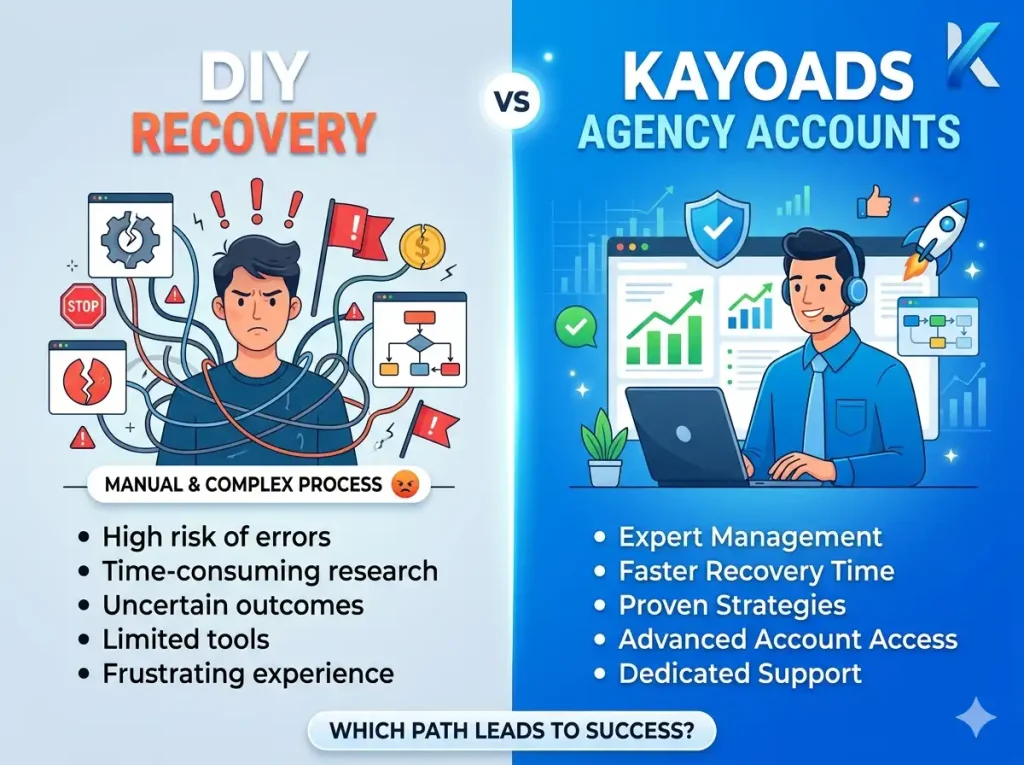
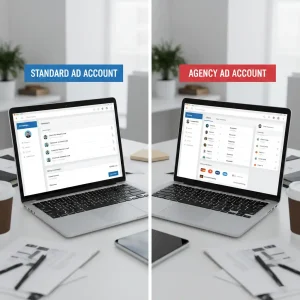
Comparison: DIY Recovery vs. KayoAds Agency Accounts
For many, the standard appeal process is a “black hole” where responses take weeks. This is why professional media buyers transition to Verified Agency Infrastructure.
| Feature | Standard DIY Meta Account | KayoAds Agency Account |
| Trust Score | Low (Bot-sensitive) | Highest (Verified Status) |
| Spend Limits | Often capped at $50–$200/day | Unlimited Scaling from Day 1 |
| Verification | User-managed (High failure rate) | Pre-vetted & Whitelisted |
| Response Time | 48+ Hours (Bot-driven) | 24/7 Dedicated Human Support |
| Ban Resilience | Minimal | Suspension-proof infrastructure |
The KayoAds Advantage: Stability for Your Brand
If you are tired of the “ban-and-appeal” cycle, it may be time to upgrade to a Meta Agency Ad Account. We provide the “armor” your campaigns need to survive Meta’s aggressive 2026 filters.
-
Suspension-Proof Accounts: Our accounts are aged and come with a pre-established legacy of trust, making them far more resilient than new DIY profiles.
-
Instant Balance Top-ups: Eliminate billing-related bans with our centralized, agency-grade funding system.
-
Verified Status: We handle the rigorous identity and business verification hurdles so you can focus on your creative strategy.
-
Direct Escalation: If an account is flagged, we have direct lines to Meta representatives to resolve the issue before it turns into a permanent ban.
2026 Pro-Tips to Prevent Future Bans
-
Avoid Direct Linking: Especially if you Run Google Ads for Affiliate Marketing, never link directly to an offer. Use a high-quality “Value-First” landing page.
-
Audit Your Team: Ensure everyone in your Business Manager has a “Clean” personal Facebook history. One “bad apple” can disable the whole orchard.
-
Use Static IPs: If you travel frequently, use a dedicated residential proxy or a clean static IP. Logging in from different countries is a major “Unauthorized Access” trigger.
Quick Checklist for Disabled Accounts:
-
[ ] Check Account Quality for specific violation codes.
-
[ ] Confirm your Advertiser Identity Verification is up to date.
-
[ ] Review your latest ads for Unacceptable Business Practices.
-
[ ] If the appeal is stuck, consider migrating to a Verified Agency Account to resume operations immediately.
Conclusion
Having your Facebook Ads account disabled is a significant roadblock, but in 2026, it is often a sign that your account infrastructure needs to be professionalized. By adhering to strict E-E-A-T principles and utilizing high-authority Agency Accounts, you can protect your business from the volatility of automated bans.

Website desgin
Using our website design and development service with KayoAds

Android & IOS
Broaden your business horizons with top-notch mobile app development services

SEO Tools
At Kayoads, we specialize in delivering top-notch SEO optimize services